$1.93M
PROPOSED ADDED ANNUAL MUNICIPAL INVESTMENT
Why stable public funding is being considered and what it means for 24/7 fire protection and emergency medical care.
We are considering a larger, more predictable municipal contribution because ambulance revenue and one-time reserves have not kept pace with the real cost of maintaining 24/7 fire and EMS readiness.
The proposal does not replace ambulance billing. It reduces dependence on revenue we cannot control and puts essential staffing, equipment, and emergency response on a more sustainable footing.
These are planning estimates from our July 2026 financial outlook. Actual tax impact can vary with final budget decisions, equalized values, municipal allocation, and other taxing jurisdictions.
$1.93M
PROPOSED ADDED ANNUAL MUNICIPAL INVESTMENT
$0.88M
2025 OPERATING DEFICIT
$1.8M
CAPITAL FUNDS USED FOR OPERATIONS, 2023–2025
Fire protection and emergency medical care depend on the same foundation: trained people, a station, ambulances, fire apparatus, communications, supplies, and mutual-aid relationships. Stable funding keeps that system ready before a call comes in.
We respond to an average of 3,600 calls each year, including fire, emergency medical, wilderness rescue, and interfacility transport calls.
The financial gap is not caused by one expense or one bad year. It comes from several pressures working together.
In 2025, around 70% of our calls were for patients with Medicare or Medicaid, only covering approximately 32% of billable cost. Medicare and Medicaid payments are limited by federal and state reimbursement.
Of the remaining 30%, those write-offs accounted for $996,000 in 2025.
From 2023 through 2025, $1.8 million was transferred from capital funds to cover the operational shortfall.
Personnel
Responders, ambulances, fire apparatus, stations, communications, and supplies must be ready at every hour, 365 days a year.
Paramedics bring advanced care directly to patients experiencing time-sensitive medical emergencies.
The investment supports fire suppression, vehicle extrication, and technical rescue: rope, confined-space, and water rescue. It also supports prevention and the protective equipment crews need to work safely.
Hands-on training, certification, and continuing education keep our career, part-time, and paid-per-call responders prepared for the wide range of emergencies we face.
Predictable replacement and maintenance schedules help keep ambulances, fire apparatus, medical equipment, radios, hose, tools, and protective gear dependable.
Stable staffing and equipment give us more options when multiple calls happen at once, while preserving mutual-aid support for neighboring communities.
During one 11½-hour period at the 2026 Sauk County Fair, our crews managed 13 calls. That included two rescues at Devil’s Lake, three medical calls at the fair while maintaining event standby, a vehicle fire, an ultramarathon medical emergency with transport, a serious crash that required Med Flight, and routine community calls and lift assists.
Events overlap. Geography, transport time, and the complexity of a call can occupy a crew and its apparatus for hours. Readiness means having enough trained people and dependable equipment to keep responding when the next call comes in.
Cross-training and shared staffing make us more efficient, but they do not create two crews from one. When personnel are committed to a transport, rescue, fire, or extended incident, they are not available for another assignment. Sustainable staffing protects the capacity to answer the next emergency without relying on one crew to cover incompatible demands at the same time.
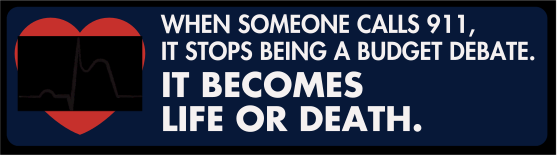
Response time is more than driving time. It begins when a 911 call is processed and continues through dispatch, crew turnout, travel, incident access, and patient contact.
Mutual aid and private ambulance providers are vital parts of the regional response system. Their units may also be committed in their own service areas, so outside resources supplement local capacity but cannot guarantee immediate coverage within the District.
Emergency information is gathered, the appropriate response is assigned, and crews are alerted.
Responders receive the call, prepare the unit, and begin the response.
Distance, road conditions, traffic, weather, and the incident location affect travel.
Crews must reach the patient or hazard, which can take additional time in large buildings, rural areas, difficult terrain, or secured locations.
Assessment and treatment begin, additional resources are requested when needed, and transport is coordinated.
Some emergencies worsen quickly. Reliable local staffing reduces the time before a trained team can assess the situation, begin appropriate care, request additional resources, and coordinate transport.
Crews can identify immediate threats, establish priorities, and determine what additional help is needed.
Responders can begin appropriate care such as CPR, defibrillation, bleeding control, airway support, oxygen, or medications.
Early assessment helps crews call for specialized equipment, more personnel, intercept resources, or medical direction.
Crews can select an appropriate destination, prepare the patient, and coordinate the next stage of care.
Choose your municipality and enter a property value. The estimate applies the proposed combined fire and EMS increase per $100,000 of equalized value.
Each municipality’s factor is its proposed additional annual contribution for combined fire and EMS service, expressed as a cost for every $100,000 of equalized property value. The factors differ because the total contribution is allocated among participating municipalities using the District’s funding model.
Estimated additional cost
Planning estimate only. This is not a property-tax bill.
$322.01 / year
$26.83 per month
Estimate for City of Baraboo based on $146.37 per $100,000 of equalized value.
$146.37 ÷ $100,000 × $220,000.00 = $322.01 per year
$146.37
per year for each $100,000 of equalized value
$116.63
per year for each $100,000 of equalized value
$58.27
per year for each $100,000 of equalized value
$82.57
per year for each $100,000 of equalized value
$63.54
per year for each $100,000 of equalized value