SKIP TO MAIN CONTENT

MEDICALPREPAREDNESS

Prepare essential medical information, communication needs, care decisions, and access details so responders can understand your needs and act quickly.

EMS CARE FORMS

PREPARE BEFORE AN EMERGENCY

Complete a full-size EMS Care Form for each household member and carry a wallet card whenever you leave home. Keep both current so responders can quickly find essential medical details when a patient cannot answer.

Choose the English or Spanish versions below. These documents stay with you; do not upload or email personal medical information through this website.

English forms

Printed copies are available for pickup at the District station.

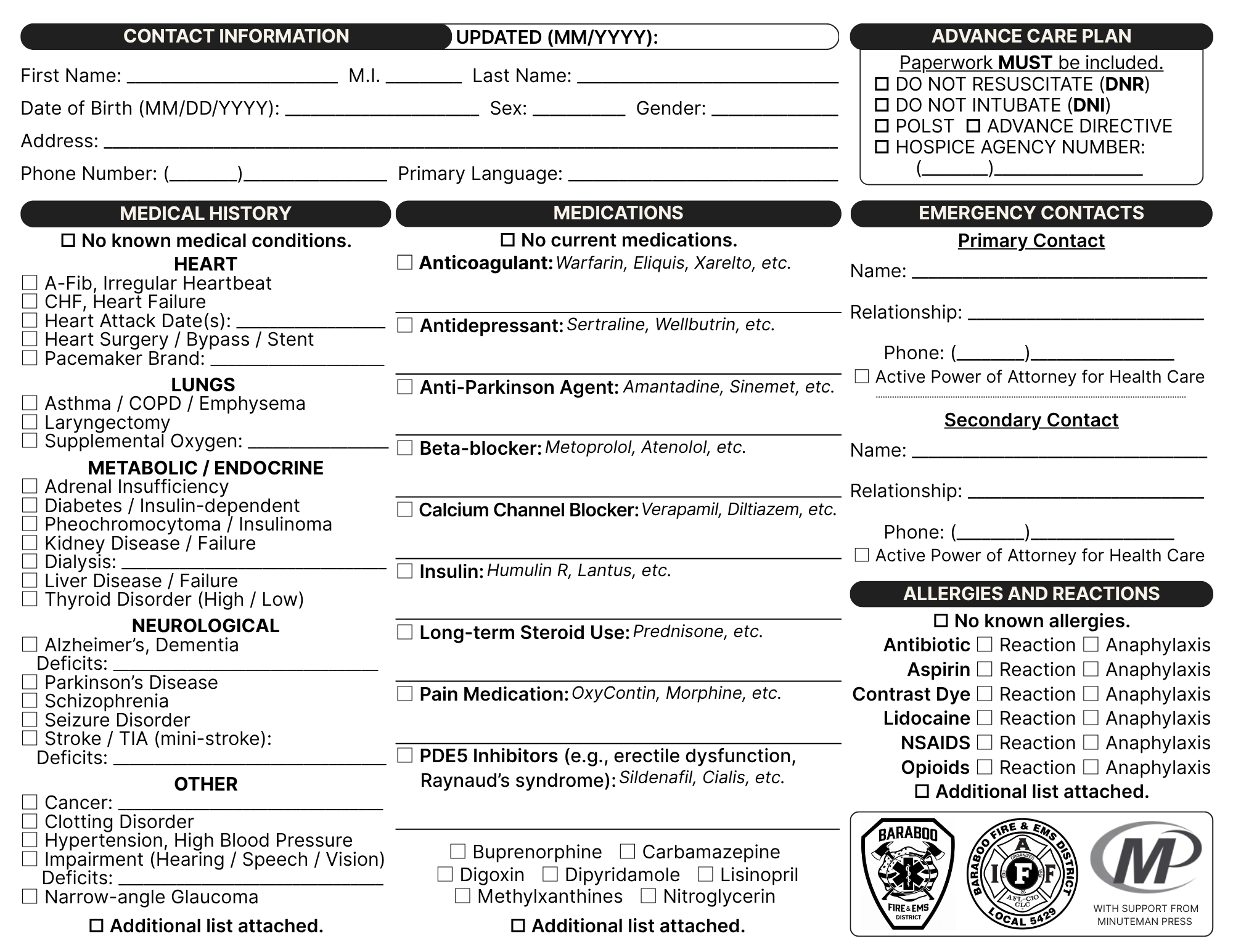
Full-size EMS Care Form

Use this when responders may need a complete picture of a person’s medical history, medicines, allergies, emergency contacts, and advance-care information at home.

Complete one for each household member and keep it where it can be found quickly—ideally on the refrigerator or in the upper-right kitchen cabinet.

Preview of the English EMS Care Form
DOWNLOAD ENGLISH EMS CARE FORM
Printing and placement notes

Fill in the form as completely as you can. Review it at least twice a year and whenever medicines, diagnoses, contacts, or care wishes change. Follow the paper-size directions printed on the selected form.

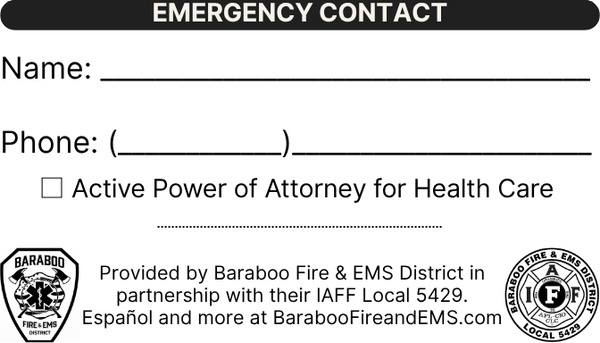
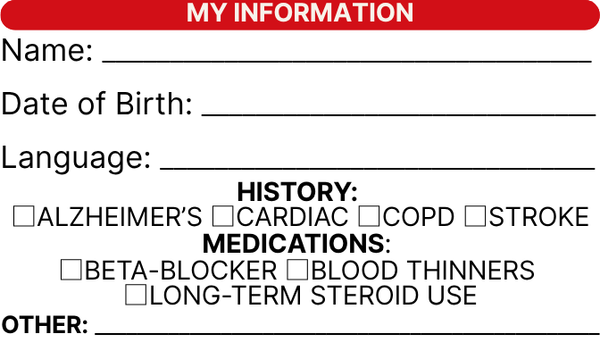
Portable EMS Wallet Card

Use this when essential medical details and an emergency contact need to travel with you. The fold-over card fits in a wallet, purse, backpack, or caregiver bag.

Complete both panels, carry the card whenever you leave home, and replace it when the information changes or the card becomes difficult to read.

Preview of the English EMS wallet card — front panelPreview of the English EMS wallet card — back panel
DOWNLOAD ENGLISH WALLET CARD
Printing and placement notes

Print on standard 8.5 × 11 inch paper at 100% or Actual Size. Cut on the outer guide, fold on the center line, and complete both sides.

WHY THESE FORMS MATTER

EMS Care Forms keep medications, allergies, medical history, emergency contacts, and care wishes in one place. During a stressful emergency, responders can use this information when a patient cannot answer and family members may not have every detail.

Formularios en español

Guarde el formulario detallado en casa y lleve la tarjeta de bolsillo con usted. Complete ambos para que los socorristas encuentren la información correcta donde ocurra una emergencia.

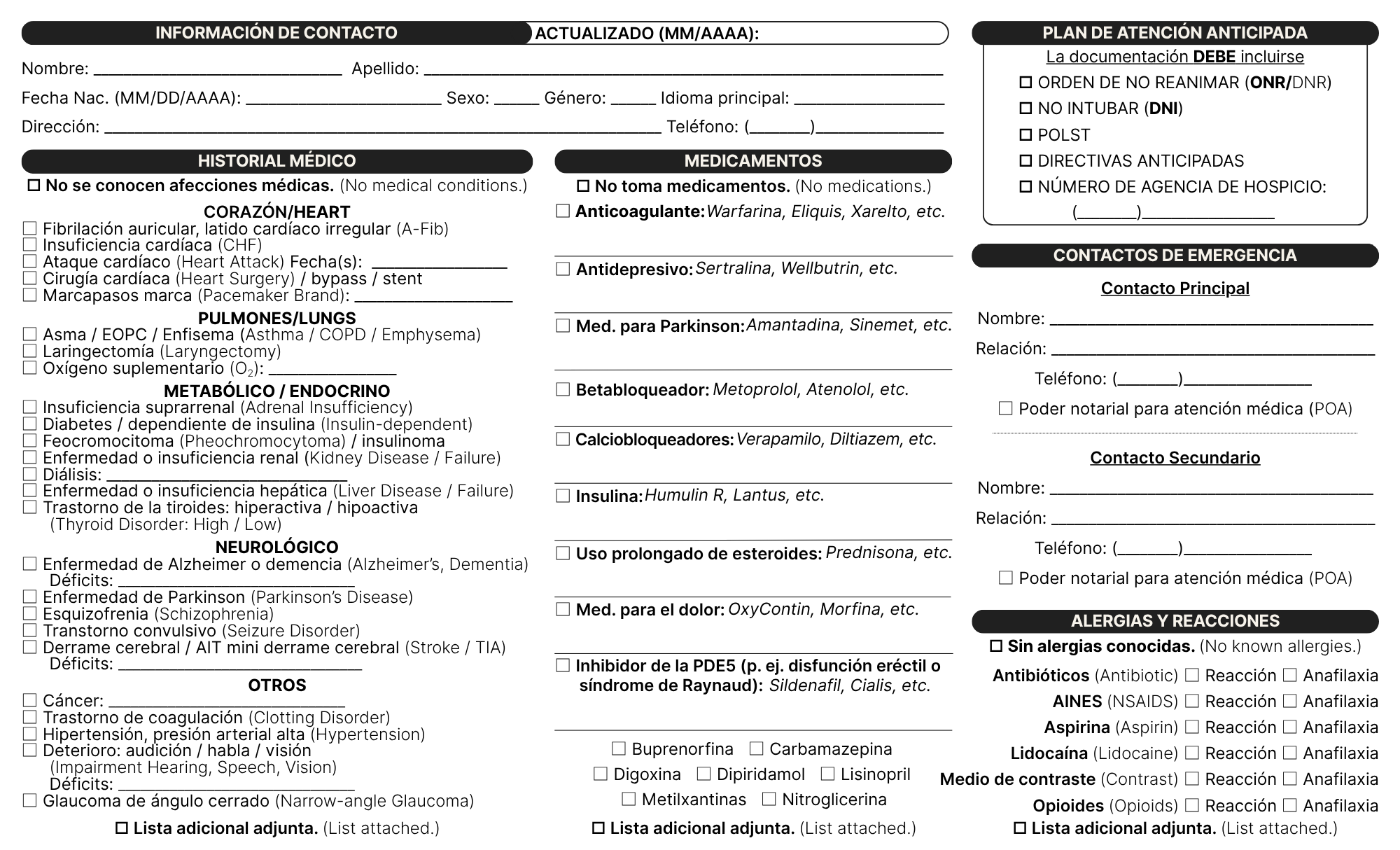
Formulario completo de atención EMS

Use este formulario cuando los socorristas puedan necesitar información completa sobre el historial médico, los medicamentos, las alergias, los contactos de emergencia y las decisiones de atención anticipada de una persona.

Complete uno para cada integrante del hogar y guárdelo donde pueda encontrarse rápidamente, de preferencia en el refrigerador o en el gabinete superior derecho de la cocina.

Vista previa del Formulario de Atención EMS en español
DESCARGAR FORMULARIO EMS EN ESPAÑOL
Notas de impresión y colocación

Complete el formulario con toda la información posible. Revíselo por lo menos dos veces al año y cada vez que cambien los medicamentos, diagnósticos, contactos o decisiones de atención. Siga las indicaciones de tamaño de papel impresas en el formulario.

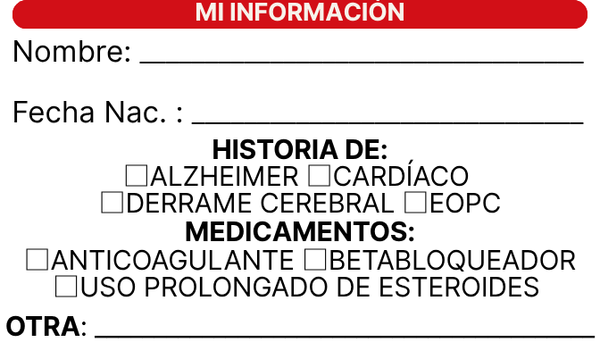
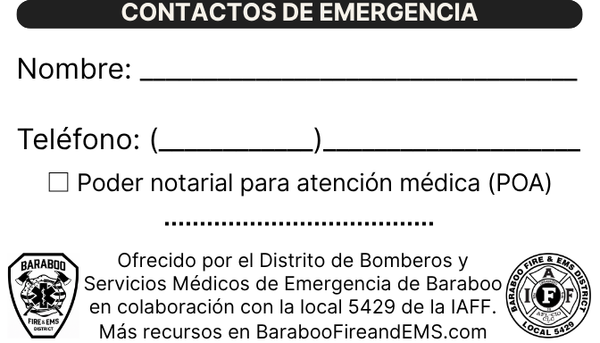
Tarjeta portátil de información EMS

Use esta tarjeta cuando necesite llevar consigo información médica esencial y un contacto de emergencia. La tarjeta plegable cabe en una billetera, bolso, mochila o bolsa del cuidador.

Complete ambos paneles, lleve la tarjeta cada vez que salga de casa y reemplácela cuando cambie la información o resulte difícil de leer.

Vista previa de la tarjeta de bolsillo EMS en español — front panelVista previa de la tarjeta de bolsillo EMS en español — back panel
DESCARGAR TARJETA EMS EN ESPAÑOL
Notas de impresión y colocación

Imprima en papel estándar de 8.5 × 11 pulgadas al 100% o en Tamaño real. Corte por la guía exterior, doble por la línea central y complete ambos lados.

START THE CONVERSATION

A stroke, a serious accident, or advanced illness can take away your ability to speak for yourself without warning. When that happens, the people around you are left to guess about the care you would have wanted. Advance care planning simply means deciding those things ahead of time, in your own words, while the choices are still yours to make.

It starts with a conversation about what matters most to you — what makes life worth living, which treatments you would want or refuse, and who you trust to carry out those wishes. Wisconsin gives that person real legal standing through a Power of Attorney for Health Care, and a Living Will records your wishes about certain life-sustaining treatment. For those already living with serious illness or advanced frailty, a conversation with a physician can turn those wishes into medical orders — a DNR or POLST — that paramedics and hospitals can act on the moment they arrive.

You do not have to do everything at once. Naming a health care agent, completing the Wisconsin forms, sharing copies with your agent, family, and care team, and revisiting your choices after any major change in health — every step you take now makes an impossibly hard moment easier for the people who love you.
This guidance draws on materials from SSM Health, UW Health, and the Wisconsin Department of Health Services.

THREE TOOLS. DIFFERENT PURPOSES.

These documents are related, but they are not interchangeable. The right combination depends on your age, health, goals, and current medical condition.

Advance Directives

A GOOD STEP FOR EVERY ADULT

Written legal documents that guide your care if you cannot speak for yourself. In Wisconsin, you can use a Power of Attorney for Health Care to name your health care agent and a Living Will to record your wishes about certain life-sustaining treatment.

You complete and sign these documents while you can make your own decisions. Share copies with your health care agent, family, and care team.

Wisconsin Do-Not-Resuscitate (DNR) Order

FOR QUALIFYING PATIENTS AFTER A CLINICIAN CONVERSATION

A Do Not Resuscitate order tells emergency responders not to start CPR if your breathing or heartbeat stops. It applies specifically to resuscitation—not to your other treatment, comfort care, or routine medical care.

Eligible adults complete the order with a health care professional. The best way to ensure EMS recognizes the order is to wear an intact, recognized Wisconsin DNR bracelet. The paper form alone does not communicate DNR status to responders.

POLST

FOR SERIOUS ILLNESS OR ADVANCED FRAILTY

POLST documents turn your current goals into portable medical orders addressing treatments that may be used during a medical crisis.

Complete this through a conversation with your physician or other authorized clinician. It complements an advance directive; it does not replace naming a health care agent.

Communication and special needs support

Voluntary programs can give dispatchers and responders useful person-specific information before an emergency occurs.

911 Functional Needs Registry

Share mobility, communication, medical-equipment, or other functional needs that may affect an emergency response.

OPEN FUNCTIONAL NEEDS REGISTRY →

Dementia Information & Support

The Alzheimer’s Association Wisconsin Chapter offers dementia information, caregiver support, local programs, and a 24/7 helpline.

VIEW DEMENTIA RESOURCES →

Prepare the way

Property access affects both fire and medical response. Keep the address visible, the route clear, pets secured, and doors accessible. Tell dispatchers about gate codes, elevators, mobility barriers, or the safest entrance.

PROPERTY ACCESS OPTIONS →